
NWU Researchers Explore How AI Tutors Impact Students with Different Styles of Learning

At Mindjoy, we spend a lot of time thinking about how AI can support learning in practical, meaningful ways. One of the most valuable and exciting moments for us is when we get to hear from educators and students themselves about how they’ve used our platform to improve teaching and learning. But sometimes, it’s just as insightful - if not more so, in different ways - to dig a little deeper below the surface.
That’s why a recent study conducted at North-West University (NWU) in South Africa caught our attention.
The research paper, “AI-Supported Tutoring and Cognitive Learning Styles in an Engineering Mathematics Refresher Course”, was written by Gustav Potgieter, Brandt Klopper, Liezl van Dyk, and Liandi van den Berg. It explored how engineering students used one of Mindjoy’s AI tutors during a one-week intensive mathematics refresher course, and what that use revealed about student engagement, learning behavior, and confidence.
We didn’t commission the research, and we had no influence on the outcomes. And, in many ways, that’s precisely what makes it so interesting to us.
The Purpose of the Study
The context is important.
Lecturers at NWU have found that many second-year engineering students arrive at advanced maths courses with gaps in foundational knowledge, making it difficult for them to progress at the necessary rate, and increasing the likelihood of students dropping out.
NWU’s Engineering Department introduced a one-week refresher program in an attempt to help strengthen those foundations before the semester began and getting students ready for the advanced math courses.
As part of the intervention, Mindjoy was integrated into the course to provide students with on-demand explanations, guided problem-solving, and immediate feedback.
In doing this, the researchers were hoping to understand three main things:
- How differently students interact with and respond to an AI tutor depending on how they prefer to learn.
- How well the AI helps students recognize and correct the mistakes or misunderstandings they commonly have in mathematics.
- How effectively the AI adjusts its support for students who think and learn in different ways, based on an assessment of their learning preferences.
This wasn’t a lab simulation. It was 49 real students, over five intensive days, juggling lectures, tests, and independent study - a very real university experience.
Here’s What They Found
The results were nuanced, which we see as a strength rather than a weakness:
- Students who engaged most with Mindjoy (defined as 38 or more interactions across the week) tended to use the tutor for real-time problem-solving, clarification, and feedback.
- Medium-engagement students used it more selectively.
- Low-engagement students (18 or fewer interactions) often cited barriers like difficulty phrasing questions, preferring face-to-face explanations, or struggling with text-heavy responses.
A particularly important finding was that engagement wasn’t evenly distributed across cognitive profiles.
For those who aren’t familiar, here’s a quick crude breakdown of the four primary cognitive profiles in learning:
- L1, Analytical thinker: Prefers logic, facts, deep analysis and objective reasoning. Learns best through critical thinking and clear data.
- L2, Organised, structural thinker: Enjoys planning, step-by-step approaches and detail-oriented learning. Thrives on routines and systematic study methods.
- R2, Interpersonal, relational thinker: Learns through interaction and cooperation, with emphasis on people, feelings and intuitive understanding.
- R1, Strategic, creative thinker: Prefers big-picture thinking, imagination, innovation and connecting ideas. Excels in unstructured, speculative learning.
That means that students with more structured, analytical styles of learning (L1 in the NBI framework) chose to use the AI tutor more often. Students with more creative (R1) and relational (R2) styles of learning seemed to engage less often.
Further to this, the findings also suggest that while the AI tutor was good at helping students fix step-by-step mistakes, deeper conceptual misunderstandings were harder to shift - especially when explanations were pretty text heavy. The research suggests that in the case of the latter, students may benefit more from visuals, examples, and questions that encourage them to think more carefully about their answers.
In short: the AI certainly worked, but not equally for everyone.
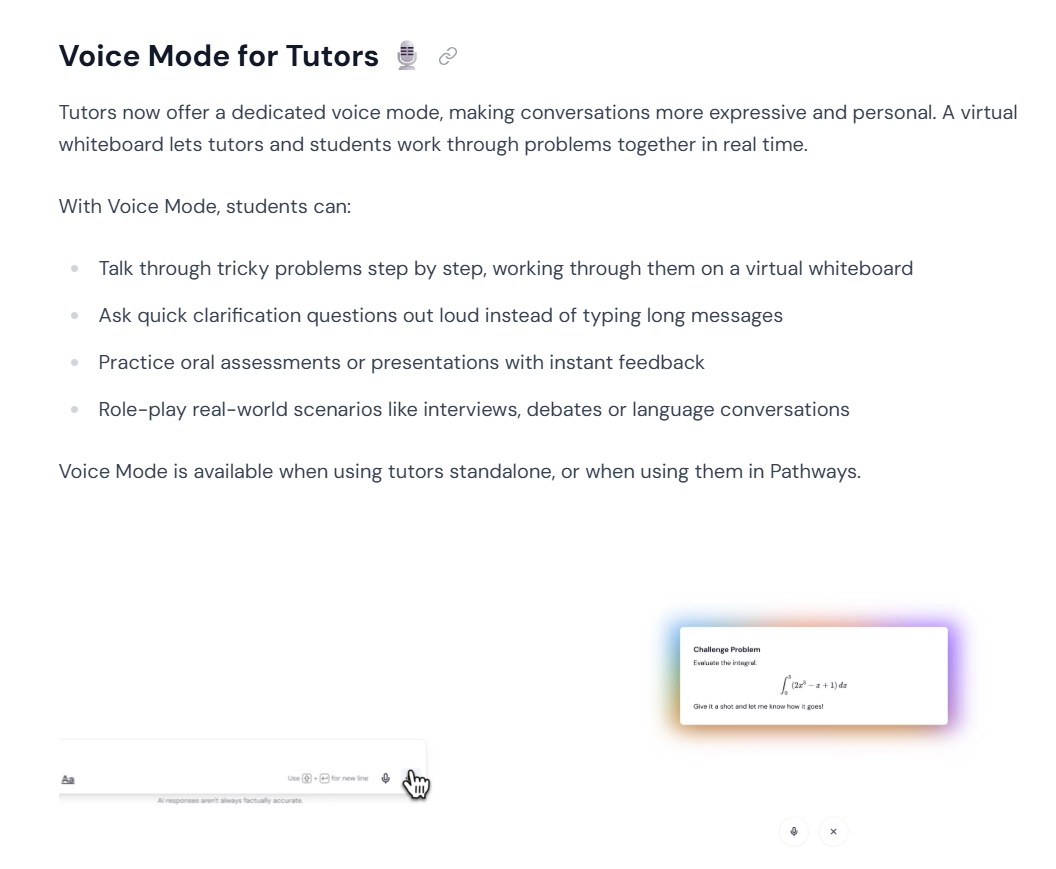
Note: since this research was conducted and the paper was published, Mindjoy has introduced a voice option, largely mitigating the above issue.
Why Does This Matter To Mindjoy?
Well, this is exactly the kind of insight we care about.
At Mindjoy, we’re not trying to build tools for only one specific type of student. We’re trying to build AI that supports all learners.
Because we know that classrooms aren’t filled with just one type of learner. They’re diverse spaces, shaped by different ways of thinking, processing, and engaging. That’s why we’re not simply aiming to impact the majority - we’re focused on reaching every student.
The paper itself highlights this. It notes that AI tutors with just text-based capabilities are most effective when students are already comfortable with text-based interaction, suggesting the need for more adaptive, diverse interfaces in future systems.
This is an exciting opportunity to learn and understand the students and educators who are using our platform on a daily basis.
An Important Finding for AI In Education
Taking a step back, this research speaks to the future of AI in education more broadly.
It shows that:
- AI tutoring can effectively support learning in high-pressure, real-world settings
- Students will engage deeply with AI when it meaningfully supports their goals
- Learners will benefit most from AI design that suits their learning style
- Educational AI needs to be designed around diversity of thinking, not just technical efficiency
As AI becomes more embedded in education systems around the world, studies like this are critical to help us understand not just what we’re doing, but how we can do it the best possible way. They move the conversation away from hype and towards evidence and progress.
We’re already aware that AI has the potential to completely transform education (and in many cases, already is). This type of research helps us focus more on what we can do to go beyond that, figuring out how we can make our tools and platforms as effective as possible to every student.
For us, the takeaway is clear. The future of educational AI isn’t just about creating smarter models - it’s about identifying, understanding, and prioritizing the heterogeneity of the humans we’re designing for.

I'm the founder of Mindjoy 🤓. I'm curious about learning, startups, resilience, systems thinking and the quest for the master algorithm. I wish to create learning contexts that kids call hard fun!